
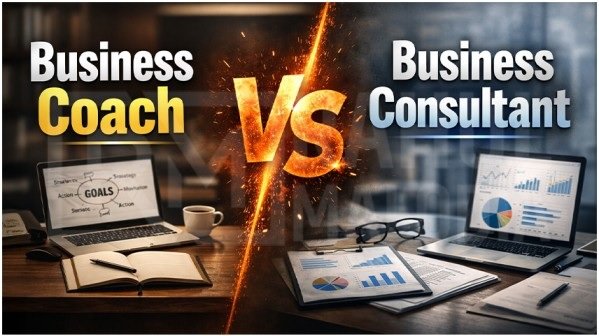
Business Consulting vs. Business Coaching: The Ultimate Guide to Choosing the Right Path for Growth
In the modern economic landscape, scaling a business is tougher than ever. Entrepreneurs, founders, and corporate executives face a non-stop wave of challenges, from sudden market shifts and technological disruptions to internal team management issues. Every ambitious leader eventually hits a plateau where their current knowledge and internal resources are simply not enough to trigger the next level of growth.
When you look for external expertise to break through these barriers, you will constantly see two professions dominating the market: Business Consulting and Business Coaching.
Many people use these terms interchangeably, assuming they mean the exact same thing. However, deploying a coach when you actually need a consultant—or vice versa—can lead to wasted money, lost time, and severe frustration. To help you make the right investment for your organization, this ultimate guide breaks down the core differences, methodologies, and practical use cases for both.
1. What is Business Consulting? (The Functional Expert)
Business consulting is entirely problem-focused and solution-driven. The relationship between a client and a consultant can be summarized in one sentence: “I have a technical problem I cannot solve, and I am paying an expert to fix it for me.”
How a Consultant Operates
A business consultant enters your company as an objective, highly specialized third-party expert. They do not focus on your personal mindset or your feelings about leadership. Instead, they focus deeply on your data, your infrastructure, and your operational workflows.
The consulting process usually follows a strict framework:
- Discovery & Audit: They gather financial data, audit existing workflows, and interview key staff.
- Diagnosis: They identify exactly where your system is losing money, dropping leads, or running inefficiently.
- The Blueprint: They present a detailed, comprehensive report outlining the precise steps required to fix the issue.
- Implementation: Depending on the contract, the consultant or their team will actually execute the strategy, build the software, or train your staff on the new system.
Common Consulting Use Cases
You should hire a business consultant when you need a plug-and-play expert for a specific, technical project. Typical examples include:
- Financial Restructuring: Creating tax-saving strategies, preparing for an investor pitch, or managing cash flow crises.
- Technology & IT: Implementing a new CRM system (like Salesforce) or upgrading cybersecurity protocols.
- Market Expansion: Conducting deep market research to launch your product in a brand-new country.
- Legal and Compliance: Aligning your company policies with updated labor laws or international trade regulations.
2. What is Business Coaching? (The Human Catalyst)
Business coaching is people-focused and growth-oriented. The philosophy behind coaching is completely different from consulting: “I want to become a better, more capable leader so that I can confidently solve any business challenge that comes my way.”
How a Coach Operates
A business coach does not claim to know your specific industry better than you do. They do not analyze your financial balance sheets or write marketing strategies for you. Instead, they focus on you—the driver of the business.
A coach operates on the belief that you already possess the innate intelligence to solve your business problems, but you are held back by blind spots, poor habits, or a lack of clarity. They use advanced questioning techniques to help you see your business objectively.
The coaching process focuses heavily on:
- Strategic Questioning: Asking open-ended, powerful questions that force you to think outside your comfort zone.
- Accountability: Setting strict weekly or monthly goals and holding you answerable for executing them.
- Mindset & Behavior: Breaking down mental barriers like imposter syndrome, decision fatigue, or the fear of delegating.
- Skill Development: Helping you build long-term personal skills such as emotional intelligence, public speaking, and active listening.
Common Coaching Use Cases
You should hire a business coach when the bottleneck in your company isn’t a lack of software or strategy, but a lack of leadership clarity. Typical examples include:
- Founder Burnout: You are working 80 hours a week, micromanaging everything, and don’t know how to step back.
- Vision & Alignment: You have lost sight of why you started the business and need to redefine your long-term 5-year vision.
- Team Synergy: You have great employees, but you struggle to motivate them, manage conflicts, or build a strong company culture.
- Executive Decision-Making: You are facing major organizational changes and need a confidential sounding board to process your thoughts before making a final decision.
You May Also Check : Hospitality Business: How to Start a Successful Hospitality Company
3. Side-by-Side Comparison: Consulting vs. Coaching
To make the distinction clear at a single glance, look at how these two professionals approach the same business elements:
| Feature | Business Consulting | Business Coaching |
|---|---|---|
| Primary Focus | The Business Systems & Processes | The Business Leader & Personnel |
| The Approach | Tells you what to do / Does it for you | Asks questions / Guides you to answers |
| Core Value | Specialized, technical expertise | Frameworks, clarity, and accountability |
| Deliverable | Reports, strategies, and implementation | Personal growth, breakthroughs, and skills |
| Time Horizon | Typically short-term (Project-based) | Long-term (Ongoing development) |
4. Which One Does Your Business Need Right Now?
To determine exactly where to allocate your budget, ask yourself these three clarifying questions:
Question 1: Do you need a “Done-For-You” or a “Done-With-You” solution?
If you want an expert to build a marketing funnel, set up your supply chain, or write your legal contracts while you focus on other things, hire a consultant. If you want someone to stand by your side, challenge your ideas, and help you map out your own expansion plan, hire a coach.
Question 2: Is the problem technical or behavioral?
If your website traffic is converting poorly, that is a technical issue—hire a digital marketing consultant. If you find yourself procrastinating on making vital sales calls because you hate rejection, that is a behavioral issue—hire a mindset or sales coach.
Question 3: What is your timeline?
Consultants are ideal for rapid, emergency intervention. If your supply chain breaks down, you need a consultant to fix it immediately. Coaches are a long-term investment. Personal growth, cultural shifts, and leadership maturity take months of consistent effort to show a return on investment.
Frequently Asked Questions (FAQs)
Q1: Can someone be both a business consultant and a business coach?
Yes. Many experienced professionals offer hybrid services. They may use coaching frameworks to build your leadership skills, but temporarily switch to a consulting role when you need them to give direct strategic advice on a specific project.
Q2: Which service is more expensive: coaching or consulting?
Consulting tends to have a higher upfront cost because you are paying for specialized technical deliverables, reports, and active implementation. Coaching is usually billed as an ongoing monthly or quarterly retainer, which can match or exceed consulting costs over a longer timeframe.
Q3: How long do consulting and coaching engagements usually last?
Consulting projects are usually short-term and milestone-based, lasting anywhere from 2 weeks to 6 months. Business coaching is an ongoing relationship that typically lasts between 6 months to a year, or even longer as the leader continues to face new scaling challenges.
Q4: How do I measure the Return on Investment (ROI) for these services?
For consulting, ROI is measured through concrete business metrics: increased revenue, reduced operational costs, or a completed software setup. For coaching, ROI is measured through behavioral transformations: better time management, lower employee turnover, faster decision-making, and reaching long-term personal goals.
Conclusion: The Ultimate Growth Formula
The most successful companies globally do not choose between consulting and coaching; they strategically use both at different stages of their evolution.
If your operations are broken, your tech stack is outdated, or you need specialized expertise, seek out a Business Consultant. But if your focus is blurry, you are feeling overwhelmed, and you want to unlock your true potential as a powerful leader, invest in a Business Coach. Recognizing whether you need a system fix or a mindset shift is the ultimate secret to unlocking your business’s next massive growth phase.