
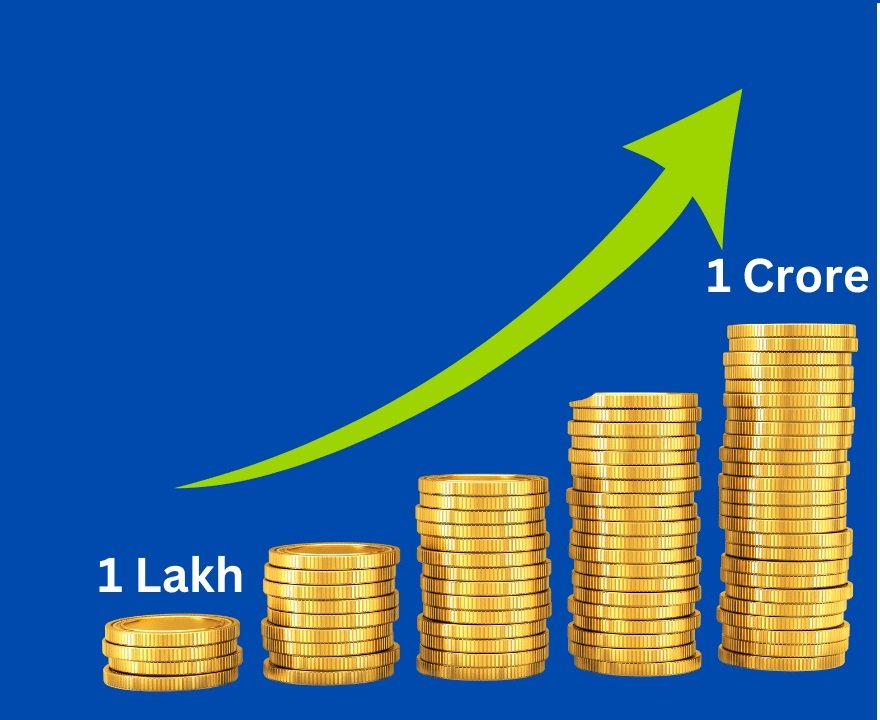
How to Grow a Business from ₹1 Lakh to ₹1 Crore: Complete Step-by-Step Roadmap
Starting a business with ₹1 lakh is possible.
Growing that business into a ₹1 crore business, however, requires a completely different mindset.
Many entrepreneurs focus only on starting.
They ask:
“What business can I start with ₹1 lakh?”
A better question is:
“What business can I start with ₹1 lakh that has the potential to scale to ₹1 crore?”
This difference is extremely important.
A business may generate ₹30,000 per month and still be difficult to scale.
Another business may start with the same ₹1 lakh but have the potential to build a large customer base, recurring revenue, distribution network or online sales channel.
This guide explains how an entrepreneur can think about the journey from ₹1 lakh to ₹1 crore, step by step.
Important: ₹1 crore can mean either annual revenue/turnover or annual profit. These are completely different targets. This roadmap primarily treats ₹1 crore as an annual revenue target.
₹1 Lakh to ₹1 Crore: Understand the Goal
First, understand the mathematics.
If your target is:
₹1 crore annual revenue
then:
₹1,00,00,000 ÷ 12 = approximately ₹8.33 lakh monthly revenue
And:
₹1,00,00,000 ÷ 365 = approximately ₹27,400 average daily revenue
This doesn’t mean you must earn exactly ₹27,400 every day.
Business revenue is rarely perfectly consistent.
The calculation simply tells you the approximate scale required.
The ₹1 Lakh → ₹1 Crore Growth Framework
A practical growth journey can be divided into seven stages:
Stage 1
₹1 lakh → ₹3 lakh
Stage 2
₹3 lakh → ₹10 lakh
Stage 3
₹10 lakh → ₹25 lakh
Stage 4
₹25 lakh → ₹50 lakh
Stage 5
₹50 lakh → ₹1 crore
Stage 6
₹1 crore → ₹3 crore
Stage 7
₹3 crore+
Each stage requires a different strategy.
Stage 1: Start With ₹1 Lakh
Step 1: Choose the Right Business Model
Don’t start with an idea simply because it is popular.
Choose a business that has:
- Real customer demand
- Healthy margins
- Repeat purchases
- Low initial fixed costs
- Scalability
- Easy customer acquisition
- Potential for online or offline expansion
Examples
Depending on your skills and market, possibilities include:
- Digital services
- Marketing agency
- AI services
- E-commerce
- Private-label products
- Food products
- Personal-care products
- Trading/distribution
- Manufacturing
- Education services
- Local business services
The right choice depends on your market, expertise, competition and execution ability.
How to Save Money on a ₹20,000 Salary: A Practical Guide With Examples
Step 2: Don’t Spend the Entire ₹1 Lakh
One of the biggest mistakes new entrepreneurs make is spending all their money before getting customers.
Suppose you have ₹1 lakh.
A possible allocation could be:
| Purpose | Approx. Allocation |
|---|---|
| Initial inventory/equipment | ₹30,000 |
| Marketing | ₹20,000 |
| Website/branding | ₹10,000 |
| Business tools | ₹5,000 |
| Packaging/operations | ₹10,000 |
| Emergency working capital | ₹25,000 |
| Total | ₹1,00,000 |
This is only an illustrative structure.
Your actual allocation should depend on your business model.
The principle is more important:
Keep enough working capital to survive while you validate the business.
Step 3: Validate Before Scaling
Before investing heavily, test the market.
Ask:
- Who is the customer?
- What problem am I solving?
- How much are customers willing to pay?
- Who are my competitors?
- Why would customers choose me?
- Can I acquire customers profitably?
- Will customers buy again?
Simple Validation Strategy
Create a basic version of your product or service.
Then approach potential customers.
Try to generate your first:
10 paying customers.
If customers are not willing to pay, don’t immediately invest more money.
Improve the offer first.
Stage 2: ₹3 Lakh Target
Once you have proven that customers will pay, the next goal is to create a repeatable sales process.
Step 4: Build a Sales Machine
You need to know exactly where customers come from.
Possible channels include:
- Google Search
- YouTube
- Local networking
- Referrals
- Marketplaces
- Distributors
- Direct sales
- Email marketing
Track every channel.
For example:
| Channel | Leads | Customers | Revenue |
| 100 | 10 | ₹50,000 | |
| Referrals | 30 | 12 | ₹60,000 |
| 50 | 8 | ₹40,000 |
You can then focus more resources on channels producing profitable customers.
Step 5: Focus on One Winning Product
Don’t launch 20 products immediately.
Find one product or service that sells consistently.
For example:
Suppose you sell five products.
Product A generates 50% of your sales.
Product B generates 25%.
The other three generate the remaining 25%.
Instead of giving equal attention to all products, investigate why Product A is winning.
Then improve:
- Packaging
- Pricing
- Quality
- Marketing
- Distribution
- Customer experience
This creates a stronger foundation.
Stage 3: ₹10 Lakh Business
At this stage, the business should begin moving from experimentation to a system.
Step 6: Separate Personal and Business Money
Open a dedicated business bank account where appropriate.
Maintain proper records for:
- Sales
- Expenses
- Inventory
- Taxes
- Receivables
- Payables
- Profit
Don’t confuse:
Revenue with profit.
If your business generates ₹10 lakh in sales but spends ₹8.5 lakh, your gross operating economics are very different from a business generating ₹10 lakh with ₹3 lakh in expenses.
Step 7: Understand Your Unit Economics
Unit economics tells you whether each sale actually makes economic sense.
For a product:
Selling Price – Variable Cost = Contribution
Example:
Selling price = ₹500
Product cost = ₹200
Packaging = ₹30
Shipping = ₹50
Payment/transaction costs = ₹20
Contribution:
₹500 – ₹300 = ₹200
If customer acquisition costs ₹150, only ₹50 remains before fixed expenses.
This tells you whether your marketing strategy is sustainable.
Step 8: Increase Average Order Value
You don’t always need more customers to increase revenue.
You can increase revenue from existing customers.
For example:
Customer buys:
₹500 product
You could offer:
- Bundle
- Premium version
- Add-on
- Subscription
- Larger pack
Suppose your average order value increases from:
₹500 → ₹750
with the same number of customers.
Revenue can increase significantly without proportionally increasing customer acquisition.
Stage 4: ₹25 Lakh Business
Now the objective changes.
You are no longer simply trying to sell.
You are building an organization.
Step 9: Hire for Bottlenecks
Don’t hire simply because the business is growing.
Hire when a specific task is limiting growth.
For example:
If you’re spending 5 hours every day answering customer messages, hire customer-support help.
If you’re spending all day packing products, hire an operations assistant.
If you’re unable to follow up with leads, hire a salesperson.
First hires may include:
- Sales executive
- Customer support
- Operations assistant
- Accountant/bookkeeper
- Digital marketer
- Production worker
Start with roles that directly remove your biggest bottleneck.
Step 10: Create Standard Operating Procedures
If only you know how everything works, the business is difficult to scale.
Create simple SOPs for:
- Sales
- Customer support
- Order processing
- Packaging
- Inventory
- Returns
- Marketing
- Accounting
- Quality control
Document the process.
Then train employees to follow it.
This transforms the business from:
“Owner-dependent”
into:
“System-dependent.”
Stage 5: ₹50 Lakh Business
At ₹50 lakh annual revenue, you should start thinking seriously about scalability.
Step 11: Build a Strong Brand
A commodity business competes primarily on price.
A strong brand competes on:
- Trust
- Quality
- Experience
- Recognition
- Positioning
Build consistency across:
- Logo
- Packaging
- Website
- Social media
- Customer communication
- Product quality
Your brand should communicate a clear answer to:
“Why should customers choose us?”
Step 12: Expand Distribution
If your product sells well in one area, don’t immediately create ten new products.
Instead, consider expanding distribution.
For example:
Level 1
Local customers
Level 2
Nearby cities
Level 3
Statewide distribution
Level 4
National online sales
Level 5
Distributors/dealers
Level 6
Institutional/B2B sales
This creates multiple routes to revenue.
Step 13: Build Multiple Sales Channels
A scalable business should ideally not depend entirely on one source of customers.
For example:
Online
- Website
- Marketplaces
- Social media
Offline
- Retailers
- Distributors
- Dealers
B2B
- Corporate customers
- Institutions
- Wholesalers
If one channel declines, other channels can support the business.
Stage 6: Reaching ₹1 Crore
Now the target is:
₹1 crore annual revenue
or approximately:
₹8.33 lakh average monthly revenue.
There are many ways to reach this number.
Revenue Model Example 1: High-Volume Product
Suppose your average order value is:
₹1,000
To generate ₹1 crore annual revenue:
₹1,00,00,000 ÷ ₹1,000
= 10,000 orders annually
That is approximately:
834 orders per month
or about:
28 orders per day
This makes the target more tangible.
Revenue Model Example 2: Subscription Business
Suppose customers pay:
₹2,000 per month
You need approximately:
₹8,33,000 ÷ ₹2,000
= 417 active customers
So approximately 400–420 active customers could generate around ₹1 crore annualized revenue at that average monthly price.
This illustrates why recurring revenue can be powerful.
Revenue Model Example 3: Service Business
Suppose your average client pays:
₹25,000 per month.
To generate approximately ₹8.33 lakh monthly revenue:
₹8,33,000 ÷ ₹25,000
≈ 34 clients
This could create a ₹1 crore annualized revenue business.
However, you must ensure that delivery capacity, employee costs and customer retention make the model profitable.
Step 14: Reinvest Profits
One of the biggest differences between a small business and a scalable business is how the owner uses profits.
Instead of withdrawing every rupee, reinvest a portion into:
- Marketing
- Inventory
- Employees
- Technology
- Distribution
- Product development
- Customer acquisition
- Training
The exact reinvestment percentage depends on the business’s margins and cash-flow needs.
The objective is:
Profit → Reinvestment → Growth → More Revenue
Step 15: Master Cash Flow
A business can be profitable on paper and still face a cash shortage.
For example:
You sell ₹10 lakh worth of goods.
But customers pay you after 60 days.
Meanwhile, suppliers require payment in 15 days.
You may have a working-capital problem.
Track:
- Accounts receivable
- Accounts payable
- Inventory
- Cash balance
- Monthly expenses
- Tax obligations
- Loan repayments
Cash flow should be monitored regularly.
The ₹1 Lakh to ₹1 Crore Business Growth Formula
A useful framework is:
Customers × Average Order Value × Purchase Frequency = Revenue
For example:
1,000 customers
× ₹1,000 average purchase
× 5 purchases per year
=
₹50 lakh annual revenue
To reach ₹1 crore, you could improve one or more variables:
- More customers
- Higher average order value
- More frequent purchases
This is much more useful than simply saying:
“I need more sales.”
Step 16: Increase Customer Retention
Acquiring a customer is often only the beginning.
Build systems for repeat purchases.
Strategies can include:
- Follow-up messages
- Loyalty programs
- Subscriptions
- Product bundles
- Memberships
- Email campaigns
- WhatsApp updates
- Personalized offers
- Excellent customer support
A customer who purchases five times can be more valuable than five customers who purchase once.
Step 17: Build a Referral System
Satisfied customers can become your marketing channel.
Create a simple referral program.
For example:
Refer a friend → receive a discount or reward.
However, make sure the economics work.
Don’t offer a reward that costs more than the additional contribution generated by the referral.
Step 18: Use Technology and AI
As the business grows, technology can reduce repetitive work.
AI and automation can help with:
- Customer support
- Content creation
- Market research
- Lead qualification
- Sales follow-ups
- Data analysis
- Reporting
- Inventory forecasting
- Email marketing
- Workflow automation
But don’t automate a broken process.
First:
Build the process.
Then:
Optimize it.
Then:
Automate it.
Step 19: Track the Right KPIs
Revenue alone doesn’t tell you whether the business is healthy.
Track:
Sales KPIs
- Monthly revenue
- Number of orders
- Average order value
- Conversion rate
Customer KPIs
- Customer acquisition cost
- Repeat purchase rate
- Customer lifetime value
- Churn/retention
Financial KPIs
- Gross margin
- Net margin
- Operating expenses
- Cash flow
- Working capital
Operational KPIs
- Inventory turnover
- Delivery time
- Return rate
- Customer complaints
Review these numbers regularly.
Step 20: Create a 12-Month Growth Plan
A practical growth plan could look like this:
| Period | Main Objective |
| Month 1 | Market research |
| Month 2 | Product/service validation |
| Month 3 | First paying customers |
| Month 4 | Improve offer |
| Month 5 | Establish sales channel |
| Month 6 | Reach repeatable sales |
| Month 7 | Hire first support |
| Month 8 | Increase marketing |
| Month 9 | Expand distribution |
| Month 10 | Improve operations |
| Month 11 | Launch new channel |
| Month 12 | Review and scale |
The exact timeline varies by industry.
Some businesses can scale faster.
Others require years.
Example: ₹1 Lakh to ₹1 Crore Product Business
Imagine an entrepreneur starts a consumer product business with ₹1 lakh.
Phase 1
Start with one product.
Goal:
10–20 customers/day
Phase 2
Improve packaging and customer experience.
Goal:
₹1–3 lakh monthly revenue
Phase 3
Add online sales.
Goal:
₹3–5 lakh monthly revenue
Phase 4
Add retailers and distributors.
Goal:
₹5–7 lakh monthly revenue
Phase 5
Build repeat purchase and bundles.
Goal:
₹7–10 lakh+ monthly revenue
Once the business reaches approximately ₹8.33 lakh average monthly revenue, the annualized revenue run rate is around ₹1 crore.
Again, this is an illustrative example, not a guarantee.
How Long Does It Take to Reach ₹1 Crore?
There is no universal timeline.
It depends on:
- Business model
- Market size
- Product demand
- Margins
- Competition
- Capital
- Sales capability
- Marketing
- Customer retention
- Execution
A high-growth digital business may scale faster than a manufacturing business.
A local service business may grow steadily but require more time to reach national scale.
Therefore, don’t focus only on speed.
Focus on:
Sustainable growth.
Should You Take a Loan to Scale?
Borrowing money can accelerate growth, but it also increases risk.
Don’t take a large loan simply because you want to reach ₹1 crore faster.
Consider debt only when:
- Demand is already proven
- Cash flows are reasonably predictable
- The borrowed money has a clear productive use
- Repayment can be handled under realistic scenarios
For example, borrowing to purchase inventory against confirmed demand is very different from borrowing heavily to test an unproven idea.
When Should You Raise Investment?
External investment can be useful for businesses that have strong growth potential and require capital to scale.
But investment also means giving up some ownership and potentially accepting investor expectations.
Before raising money, understand:
- Valuation
- Equity dilution
- Investor rights
- Use of funds
- Governance
- Future fundraising
- Exit expectations
Don’t raise investment simply because you haven’t figured out profitability.
10 Rules for Growing from ₹1 Lakh to ₹1 Crore
Rule 1
Start small.
Rule 2
Validate demand before scaling.
Rule 3
Track every rupee.
Rule 4
Focus on profitable customers.
Rule 5
Build repeat purchases.
Rule 6
Reinvest strategically.
Rule 7
Document your processes.
Rule 8
Hire around bottlenecks.
Rule 9
Diversify customer acquisition channels.
Rule 10
Scale only after the business model works.
Common Mistakes That Stop Business Growth
Spending Too Much Too Early
A beautiful office doesn’t create customers.
Launching Too Many Products
More products can create inventory and operational complexity.
Ignoring Cash Flow
Revenue doesn’t automatically mean cash in the bank.
Depending on One Customer
Losing one major customer can seriously damage a small business.
Competing Only on Price
Low prices can destroy margins.
Hiring Too Quickly
Employees should solve real bottlenecks.
Scaling Before Product-Market Fit
If customers don’t love the product at small scale, increasing marketing won’t necessarily fix the problem.
The Ultimate ₹1 Lakh to ₹1 Crore Roadmap
The journey can be summarized as:
₹1 Lakh
Find a problem
↓
₹3 Lakh
Find paying customers
↓
₹10 Lakh
Build repeatable sales
↓
₹25 Lakh
Build systems
↓
₹50 Lakh
Build brand + distribution
↓
₹1 Crore
Build a scalable organization
The strategy changes at every stage.
At ₹1 lakh, you need validation.
At ₹10 lakh, you need repeatability.
At ₹25 lakh, you need systems.
At ₹50 lakh, you need distribution and management.
At ₹1 crore, you need professionalization and scalable processes.
Final Conclusion
Growing a business from ₹1 lakh to ₹1 crore is not about finding a magical business idea.
It is about building a repeatable economic system.
Start with a real customer problem.
Create a product or service customers are willing to pay for.
Get the first 10 customers.
Improve the offer.
Build predictable sales.
Understand your unit economics.
Increase customer retention.
Document processes.
Hire around bottlenecks.
Expand distribution.
Use technology and automation.
Reinvest intelligently.
Monitor cash flow.
Then scale.
The most important mindset shift is this:
Don’t ask, “How can I make ₹1 crore?” Ask, “What system can consistently create ₹8–9 lakh of monthly revenue while remaining profitable?”
Once you can answer that question with real numbers, ₹1 crore stops being an abstract goal and becomes a measurable business target.
Start with ₹1 lakh. Prove the model. Build the system. Scale the system.
Frequently Asked Questions
Can I start a business with ₹1 lakh and reach ₹1 crore?
Yes, it is possible for some business models, but there is no guarantee. Reaching ₹1 crore depends on demand, margins, sales, customer retention, capital, competition and execution.
How much monthly revenue is required for a ₹1 crore business?
₹1 crore annual revenue divided by 12 months is approximately ₹8.33 lakh per month on average.
Is ₹1 crore revenue the same as ₹1 crore profit?
No. Revenue is total sales. Profit is what remains after applicable costs and expenses. A business with ₹1 crore revenue may have a much smaller profit.
What is the best business to start with ₹1 lakh?
Potential options include digital services, specialized agencies, e-commerce, private-label products, food businesses, education services, local services and certain trading/distribution models. The best choice depends on your skills, market and unit economics.
Should I reinvest my profits?
Reinvesting a portion of profits can help a growing business increase marketing, inventory, employees, technology and distribution. The appropriate amount depends on cash flow and business needs.
How can I increase business revenue without getting more customers?
You can potentially increase revenue by improving:
- Average order value
- Purchase frequency
- Customer retention
- Product bundles
- Premium products
- Subscription revenue
- Cross-selling and upselling
What is the biggest challenge when scaling a small business?
The biggest challenge often shifts over time. Initially it may be finding customers. Later it can become hiring, cash flow, operations, quality control, customer retention or management.
Is taking a business loan necessary to reach ₹1 crore?
No. Some businesses can grow through retained earnings and reinvestment. Debt may accelerate growth but also creates repayment obligations and risk.
Disclaimer
The information provided in this article, “How to Grow a Business from ₹1 Lakh to ₹1 Crore: Complete Step-by-Step Roadmap,” is intended for general informational and educational purposes only.
The business ideas, revenue examples, investment figures, growth strategies, calculations, and financial scenarios mentioned in this article are illustrative examples and should not be considered as a guarantee of business success, income, profit, or financial returns.
Actual business results may vary significantly depending on factors such as:
- Market demand
- Business model
- Product or service quality
- Competition
- Location
- Customer acquisition
- Pricing
- Operating expenses
- Available capital
- Management skills
- Economic conditions
- Government regulations
- Taxation
- Execution and business experience
A target of ₹1 crore in annual revenue does not mean ₹1 crore in profit. Revenue, gross profit, net profit, cash flow, and business valuation are different financial concepts.
Readers should conduct their own market research and carefully evaluate the risks, costs, legal requirements, taxation, licenses, registrations, financing options, and other applicable regulations before starting or expanding a business.
Any reference to loans, investments, equity, funding, profitability, or expected revenue should not be interpreted as financial, investment, legal, tax, or professional advice.
VyaparTips.com does not guarantee any specific income, revenue, profit, business growth, or return on investment based on the information provided in this article.
Before making significant financial or business decisions, readers should consider consulting a qualified financial advisor, Chartered Accountant, lawyer, tax professional, or other appropriate professional, depending on their specific circumstances.
By using the information provided on VyaparTips.com, you acknowledge that you are responsible for your own business and financial decisions and that you should independently verify information before acting upon it.
Last Updated: August 2026