
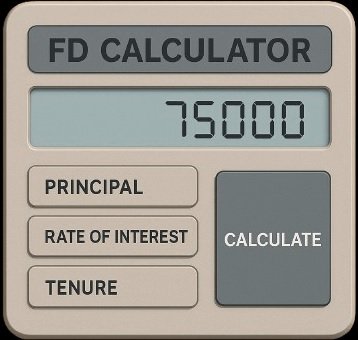
Bank FD Calculator – Calculate Fixed Deposit Interest & Maturity Amount Online
What is a Bank FD Calculator?
A Bank Fixed Deposit (FD) Calculator is a free online financial tool that helps investors calculate the maturity amount and total interest earned on their Fixed Deposit investments. By entering the deposit amount, interest rate, tenure, and compounding frequency, you can instantly determine how much your investment will grow over time.
Fixed Deposits are among the most popular and secure investment options, making them suitable for both short-term and long-term financial goals.
What is a Fixed Deposit (FD)?
A Fixed Deposit (FD) is a financial investment offered by banks and financial institutions where a lump sum amount is deposited for a fixed period at a predetermined interest rate.
At the end of the tenure, the investor receives:
Principal Amount
Interest Earned
Total Maturity Amount
Fixed Deposits are preferred because they offer:
Guaranteed returns
Low investment risk
Flexible investment tenure
Attractive interest rates
Convenient liquidity options
How Does the Bank FD Calculator Work?
The FD Calculator requires four basic inputs:
Deposit Amount
Annual Interest Rate
Investment Tenure
Compounding Frequency
After entering these details, the calculator instantly provides:
Total Interest Earned
Maturity Amount
Investment Summary
Principal vs Interest Breakdown
This helps investors make better financial decisions before investing.
Bank FD Formula
The maturity amount is calculated using the following formula:
A = P × (1 + R/N)(N×T)
Where:
A = Maturity Amount
P = Principal Amount
R = Annual Interest Rate
N = Number of Compounding Periods in a Year
T = Investment Tenure (Years)
Our FD Calculator performs these calculations instantly without requiring manual computations.
Fixed Deposit Calculation Example
Suppose:
Deposit Amount = ₹1,00,000
Interest Rate = 7% Per Year
Investment Period = 5 Years
Compounding = Quarterly
The calculator will estimate:
Principal Amount = ₹1,00,000
Total Interest Earned
Maturity Amount
Investment Growth Summary
This allows investors to compare various investment durations and interest rates conveniently.
Types of Fixed Deposits
Regular Fixed Deposit
Suitable for salaried individuals and general investors seeking stable returns.
Senior Citizen Fixed Deposit
Senior citizens are often offered higher interest rates than regular depositors.
Tax Saving Fixed Deposit
These deposits generally have a lock-in period and may offer tax benefits subject to applicable tax laws.
Cumulative Fixed Deposit
Interest is compounded periodically and paid along with the maturity amount.
Non-Cumulative Fixed Deposit
Interest is paid at regular intervals such as monthly, quarterly, or annually.
Benefits of Investing in Fixed Deposits
Fixed Deposits offer several advantages:
Capital protection
Predictable returns
Flexible investment tenures
Low financial risk
Easy investment process
Suitable for conservative investors
Better financial planning
Convenient nomination facilities
FDs remain one of the preferred investment choices for risk-averse investors.
What is Compounding in Fixed Deposits?
Compounding refers to earning interest on both the principal amount and previously earned interest.
Common compounding frequencies include:
Monthly
Quarterly
Half-Yearly
Yearly
Generally, more frequent compounding can result in slightly higher maturity amounts.
Example
| Compounding Frequency | Growth Potential |
|---|---|
| Yearly | Standard |
| Half-Yearly | Higher |
| Quarterly | Better |
| Monthly | Maximum among these options |
The actual returns depend upon the applicable interest rate and investment tenure.
Factors Affecting FD Returns
Several factors influence your FD maturity amount:
Deposit Amount
Higher investments generally produce higher returns.
Interest Rate
A small increase in interest rates can significantly improve maturity values over longer tenures.
Investment Tenure
Longer investment periods usually provide greater compounding benefits.
Compounding Frequency
Monthly or quarterly compounding may offer better returns compared to annual compounding in certain cases.
Why Should You Use an FD Calculator?
An FD Calculator helps investors:
Estimate maturity amounts instantly.
Compare investment plans.
Plan financial goals efficiently.
Save calculation time.
Make informed investment decisions.
Analyse compounding benefits.
Understand investment growth potential.
It is particularly useful when comparing multiple investment tenures and interest rates.
Who Can Use This Calculator?
This calculator is suitable for:
Salaried Employees
Business Owners
Students
Senior Citizens
Homemakers
Retired Individuals
Investors
Freelancers
Self-Employed Professionals
Anyone planning to invest in Fixed Deposits can benefit from using this calculator.
FD vs Savings Account
| Particular | Fixed Deposit | Savings Account |
|---|---|---|
| Returns | Higher | Lower |
| Investment Period | Fixed | Flexible |
| Risk | Low | Low |
| Liquidity | Moderate | High |
| Wealth Creation | Better | Limited |
Fixed Deposits are generally preferred for achieving medium and long-term financial goals.
Tips Before Investing in Fixed Deposits
Before investing, consider the following:
Compare FD interest rates.
Select an appropriate investment tenure.
Understand premature withdrawal rules.
Check compounding frequencies.
Evaluate tax implications.
Diversify investments when necessary.
Align investments with your financial objectives.
Proper financial planning can significantly improve investment outcomes.
Frequently Asked Questions (FAQs)
1. What is a Bank FD Calculator?
It is an online tool used to calculate the maturity amount and interest earned on Fixed Deposit investments.
2. Is the FD Calculator free to use?
Yes, our Bank FD Calculator is completely free.
3. What details are required for calculation?
You need:
Deposit Amount
Interest Rate
Investment Tenure
Compounding Frequency
4. What is the maturity amount?
The maturity amount is the total amount received at the end of the FD tenure, including both principal and interest.
5. Can senior citizens use this calculator?
Yes. Senior citizens can calculate returns using their applicable interest rates.
6. Does compounding frequency affect returns?
Yes. More frequent compounding generally results in higher maturity values.
7. Is Fixed Deposit a safe investment?
Fixed Deposits are widely considered relatively low-risk investment products compared with many market-linked investments.
8. Can I calculate monthly compounding?
Yes. Our calculator supports monthly, quarterly, half-yearly, and yearly compounding frequencies.
9. Is tax applicable on FD interest?
Interest earned on Fixed Deposits may be taxable depending on the applicable tax regulations and the investor’s circumstances.
10. Why should I use an FD Calculator before investing?
An FD Calculator helps you estimate returns accurately and choose the most suitable investment option based on your financial goals.
Conclusion
A Bank FD Calculator is an essential financial planning tool for investors seeking safe and predictable returns. It allows you to calculate maturity amounts, analyse the impact of compounding, and compare different investment options effortlessly. Whether you’re investing for short-term goals or long-term wealth creation, using an FD Calculator can help you make smarter and more informed financial decisions.
Use our free Bank FD Calculator today to estimate your returns and plan your investments with confidence.